
Recycling and Sustainability for Oven Cleaner Products
Our commitment to sustainable oven cleaning means treating every oven cleaner product lifecycle as an opportunity to reduce waste, cut carbon and support local communities. This page explains our recycling percentage target, how we work with local transfer stations, our partnerships with charities and the rollout of low-carbon vans. By integrating product stewardship across packaging, transport and community programmes, our oven-cleaning solutions aim to be part of the circular economy, not part of the problem.

Ambitious Recycling Percentage Target
We have set a clear target: achieve a minimum 75% recycling rate for all primary and secondary packaging for our oven-cleaner ranges by 2028. That target covers refill pouches, aerosol cans where applicable, plastic bottles and cardboard cartons. Progress is measured annually and reported in our sustainability statements. We believe a quantifiable goal helps suppliers, local councils and retailers align their own waste separation and collection schemes with our objectives.
Packaging and Local Waste Separation
The success of our target depends on local borough approaches to waste separation. Many boroughs now operate separate streams — paper and cardboard (blue or green bins), rigid plastics and metals (mixed recycling), glass and a residual bin for non-recyclables. We design our packaging to be compatible with these systems: mono-material bottles, clearly marked recyclable labels and collapsible refill pouches that reduce transport volume. To complement municipal services we support transfer station capacity upgrades and material recovery facilities (MRFs), ensuring that recovered materials from oven cleaning product packaging stay in the loop and are reprocessed locally where possible.
Local Transfer Stations and Collection Networks
We work with several local transfer stations and waste logistics providers to streamline collection. By routing sorted recyclables from retailers and community collection points through nearby transfer stations, we reduce haul distance and avoid unnecessary long-distance freight. Transfer stations play a crucial role in consolidating loads for recycling processors and in segregating aerosol and chemical-containing items for safe handling.Key collaborative activities include:
- Supporting capacity upgrades at transfer stations to accept sealed aerosol containers for specialist processing.
- Funding local MRF improvements so plastic and cardboard are higher quality for remanufacture.
- Coordinating with borough waste teams to align collection calendars and special waste collection events.
Partnerships with Charities and Community Groups
We partner with charities that focus on household support and environmental programmes. These partnerships are not about product giveaways but about creating value: refurbishing reusable containers, facilitating social enterprises that repair or redistribute equipment used alongside oven cleaning, and funding local projects that improve recycling literacy. Our collaborations also support job training in materials sorting and transfer-station operations, helping local residents gain skills in the circular economy.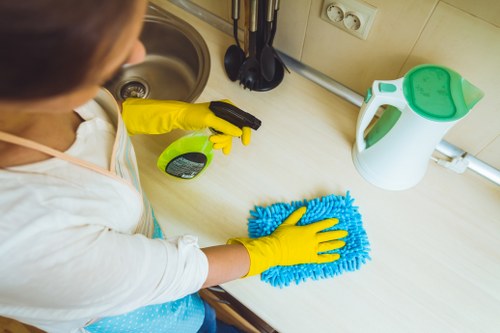
Low-Carbon Vans and Greener Distribution
Transport is a major part of our emissions profile. We have begun replacing older delivery vehicles with low-carbon vans — a mix of battery-electric and plug-in hybrids — for last-mile distribution of concentrates, refills and replacement bottles. These low-emission vans reduce urban air pollution and, when combined with route optimisation, cut fleet CO2 by an estimated 40% per delivery compared to our 2019 baseline.Our logistics partners are incentivised through procurement contracts to adopt low-carbon vehicles and to improve load efficiency. Stronger coordination with local depots and transfer stations further reduces empty miles and keeps the carbon footprint of our oven-cleaning supply chain as low as possible.
Design and materials choices also support emissions reduction: concentrated formulas mean smaller packages and fewer vehicle trips, and bottles made with recycled PET reduce upstream emissions compared to virgin plastics.

Local Recycling Activities and Borough Initiatives
Across the regions where we operate, borough councils run a variety of schemes that support recycling of cleaning-product packaging. Typical approaches we align with include:- Kerbside sort or co-mingled recycling collection for plastics, metals and glass.
- Household hazardous waste collection days and dedicated centres for chemical containers.
- Community bring schemes for aerosols and bulky items.
We work with borough waste planners to ensure our oven-cleaner containers are accepted, and we share packaging data to help councils plan processing flows. When local regulations differ, we adapt our product labels and logistics to remain compliant and recyclable under each jurisdiction's rules.
Our sustainability journey is ongoing: we report publicly on recycling rates, invest in transfer station upgrades, partner with charities to create circular social value and continue to electrify our fleet. By focusing on measurable targets, local collaboration and low-carbon transport, our oven-cleaning range aims to be both effective and responsible. We invite local authorities and community groups to continue working with us as we refine these programmes and increase the reuse and recycling of oven-cleaning packaging across boroughs and districts.